
Starting a new café is a dream, but an equipment catalog can feel like a nightmare. Get your first big purchase right, and your kitchen runs smoothly. Get it wrong, and you’re stuck with a multi-thousand-dollar mistake that bleeds cash. This guide is your cheat sheet to choosing the perfect fit—no engineering degree required.
Before getting lost in brands, understand that commercial refrigeration falls into two simple families. The first is Storage Refrigeration, your back-of-house workhorse for bulk ingredients. The second is Active Use/Display Refrigeration, which is part of your daily workflow or customer-facing setup.
Deciding which family you need first makes finding the right unit infinitely easier. For instance, a small pizzeria might debate between a reach-in vs. a walk-in cooler for storing 50-pound bags of cheese (Storage), while its refrigerated prep table (Active Use) is non-negotiable for the service line. This distinction turns an overwhelming catalog into a handful of confident choices.
Reach-In Refrigerators: The Unsung Workhorse
If you’re picturing the standard, stainless-steel workhorse of a professional kitchen, you’re thinking of a reach-in refrigerator. It’s the heavy-duty version of your home fridge, built to withstand the constant opening of a busy service. Its job is to keep daily ingredients—prepped vegetables, sauces, and proteins—safely chilled and within arm’s reach, making it perfect for “active use” storage.
The main decision here is the number of doors. A single-door model is perfect for a tight space like a food truck, while a two-door unit offers a great balance of capacity for most small restaurants. Three-door models are for high-volume kitchens that need lots of organized storage. The choice depends directly on your inventory needs and kitchen floor plan.
For most new ventures, a one or two-door reach-in is the smartest first investment. It’s designed to meet critical restaurant refrigerator temperature requirements (below 40°F / 4°C), helping you pass health inspections and protect inventory from spoilage. But what happens when you start buying in bulk? That’s when you need a bigger solution.
Walk-In Coolers & Freezers: When to Invest in Bulk Storage
Eventually, a busy kitchen faces a good problem: you’re selling so much that your reach-ins are overflowing. This is the classic tipping point in the reach-in vs. walk-in cooler debate. When considering a third or fourth reach-in, it’s often more cost-effective and space-efficient to consolidate with a single walk-in.
As the name suggests, a walk-in is a refrigerated room you can enter, perfect for storing cases of produce, large boxes of protein, or buckets of sauce. These units act as your long-term inventory hub, freeing up your reach-ins for only the items your staff needs to grab quickly during service. This separation of bulk and active inventory is key to an organized, efficient kitchen.
However, the decision involves more than the purchase price. The total cost of a commercial walk-in includes professional assembly (not a DIY job) and potentially electrical and structural modifications to your building. For hot kitchens, you might even consider a remote compressor, which places the noisy, heat-producing part of the unit outside to improve the work environment.
The real power of a walk-in is unlocking economies of scale. While the upfront investment is significant, it allows you to buy ingredients in larger quantities at a lower per-item cost, reducing food waste and supplier delivery fees over time. It’s an investment that pays for itself as your business grows.
Refrigerated Prep Tables: Your Secret to a Faster Service Line
While a walk-in is for backup inventory, it does little to help during a lunch rush. This is where the refrigerated prep table becomes a game-changer. It’s a high-performance workstation that combines a cutting board with refrigerated cabinets or drawers directly underneath, solving one of the biggest kitchen bottlenecks: walking back and forth for ingredients.
For any business that assembles food to order, this equipment is non-negotiable. The many prep table refrigerator uses make it the heart of a sandwich shop, pizzeria, or salad bar. Its key feature is the recessed, refrigerated cold well on top, designed to hold standard food pans of chopped vegetables, sliced meats, and cheeses at a food-safe temperature. Its efficiency makes it one of the best refrigerators for a small cafe or the primary unit in refrigeration for food trucks.
Ultimately, the value of a prep table is speed. By keeping everything within arm’s reach, you shorten order times, improve consistency, and serve more customers. It’s a direct investment in your kitchen’s workflow.
Glass-Door Merchandisers: Turn Cold Storage into Sales
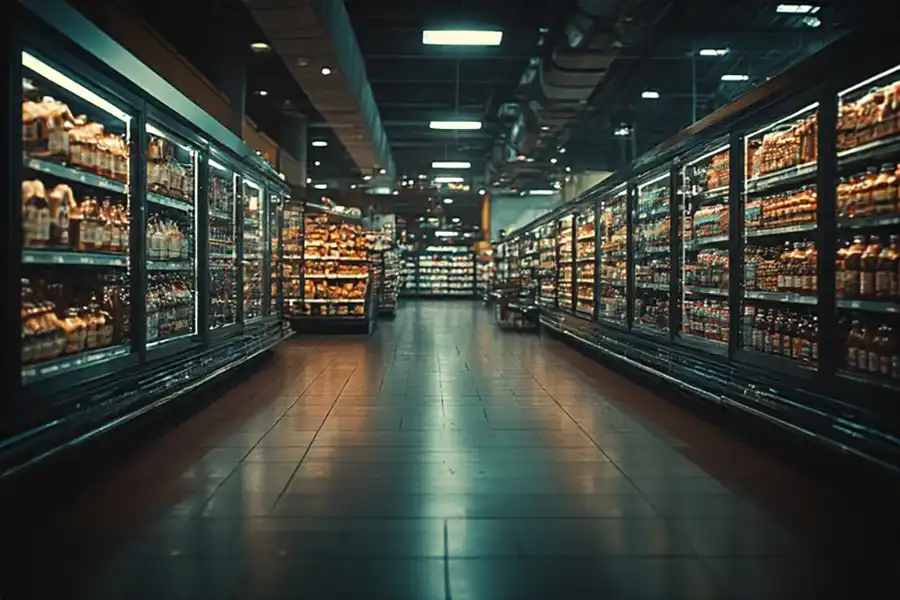
Unlike the solid-door workhorses in your kitchen, a merchandiser is a refrigerator designed to be a silent salesperson. With bright interior lighting and a clear view, its purpose is to make products look appealing and encourage customers to grab something on their own. This is the key difference in the glass door vs. solid door merchandiser choice: one is for storage, the other is for selling.
A merchandiser’s power lies in its placement. By positioning one near your Point of Sale (POS), you tap into the power of the impulse buy. When a customer is waiting to pay, a well-stocked display of cold drinks or desserts can easily turn into an extra, high-margin sale.
There is a trade-off. Glass is not as efficient an insulator as a solid door, so these units use more energy. However, this is a calculated business decision. For most businesses, the increased revenue from spontaneous purchases far outweighs the slightly higher electricity bill, making it a smart investment in profitability.
Undercounter Refrigerators: Maximize Every Square Inch
When floor space is precious, the best place to add refrigeration might be right under your counter. Undercounter refrigerators are compact, front-breathing units designed to slide into the dead space beneath work surfaces. This creates cold storage exactly where staff needs it most, transforming an empty cabinet into a productive workspace.
The real magic of an undercounter unit is how it supercharges workstation efficiency. A barista no longer has to walk to the main fridge for milk, and a bartender has garnishes and juices within reach. By eliminating extra steps, you speed up service, reduce staff traffic, and create a smoother workflow.
It’s tempting to use a cheap residential mini-fridge, but this is a classic first-timer mistake. A commercial undercounter unit has a powerful compressor that recovers its temperature quickly in a hot, busy environment, keeping products safe and preventing health code violations. A home unit simply can’t keep up.
Compressor 101: Why Top-Mount vs. Bottom-Mount Matters
Every commercial refrigerator has a compressor—the hardworking engine that does the cooling. Where this engine is located is a critical decision that impacts cleaning, ease of use, and performance in your kitchen.
- Top-Mount: The compressor sits on top, away from floor dust and debris, which is a huge advantage in bakeries or pizzerias where flour is in the air. The trade-off is that it pulls in hotter air that naturally rises, which can make it work harder in steamy kitchens.
- Bottom-Mount: With the compressor at the base, the bottom shelf is higher, so staff don’t have to bend as far to grab heavy items. These units are also easier for technicians to service. The drawback is that they can suck in floor dirt and grease, requiring more diligent cleaning to prevent breakdowns.
Choosing correctly from the start leads to more energy-efficient commercial refrigeration and fewer headaches down the road.
Glass Doors vs. Solid Doors: Efficiency vs. Visibility
Deciding between solid and glass doors is a classic tug-of-war between saving energy and seeing your inventory. Solid doors are the undisputed champions of insulation. They are fantastic at trapping cold air, which means your compressor runs less often and lowers your energy bill. This makes a solid-door reach-in the go-to for back-of-house storage where efficiency is the top priority.
So why choose glass? The answer is speed and workflow. In a fast-paced kitchen, a glass door lets your team locate ingredients instantly without opening the door to hunt around. This quick-glance advantage means the door spends less time open, helping the unit maintain its temperature while staff moves faster. While often associated with customer-facing merchandisers, this benefit is just as valuable for a kitchen prep line.
For bulk ingredients, a solid-door unit offers the most energy-efficient refrigeration. But for a busy prep line, the workflow boost from a glass door is often worth the trade-off.
The Non-Negotiables: NSF Certification and Temperature Safety
Beyond the physical build, some features are simply required for passing a health inspection. The small, circular blue NSF seal on commercial equipment is a passport that proves your unit meets strict public health standards for safety and cleanability. An NSF certified refrigeration mark gives inspectors immediate confidence that your equipment is designed for a professional kitchen.
This certification supports a refrigerator’s most critical job: keeping food out of the temperature “Danger Zone.” This is the range between 40°F and 140°F (4°C and 60°C) where bacteria multiply rapidly. Your unit must be powerful enough to keep all food safely below 40°F, even during a busy service. A commercial unit is engineered for this heavy use and rapid temperature recovery.
It can be tempting to save money with a non-certified unit, but this is one of the costliest mistakes a new owner can make. That initial savings vanishes the moment you fail a health inspection and are forced to replace the equipment.
Your 5-Step Checklist to Finding the Perfect Refrigerator
To translate your knowledge into an action plan, answer these five questions. This will help you choose a unit that protects your inventory, empowers your staff, and supports your bottom line.
- What’s on Your Menu? (This determines if you need a prep table for assembly, a reach-in for ingredients, or a merchandiser for grab-and-go items.)
- How Much Space Do You Have? (This guides your decision between a standard reach-in, a compact undercounter unit, or a high-capacity walk-in.)
- What’s Your Daily Workflow? (Consider if your staff needs ingredients at their stations in an undercounter unit or if a central reach-in is more efficient.)
- Will Customers See the Unit? (This is the key to choosing between a functional stainless steel finish and a customer-facing glass-door merchandiser.)
- What is Your Real Budget? (Look beyond the price tag to factor in long-term energy costs—a key difference between solid and glass doors.)
Answering these questions helps you design your kitchen’s future. This isn’t just an appliance—it’s the heart of your business, and now you can be sure you’re choosing one built for success.
Autumn Mechanical
18812 Tomato St.
Spring, TX 77379
(713) 864-8368
View our Google Business Listing
View our Facebook Page