
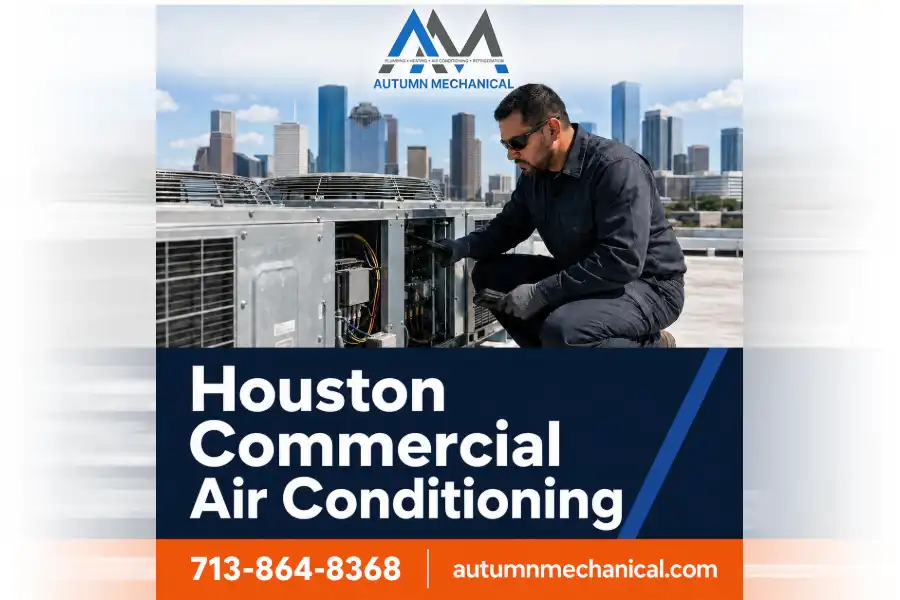
A dependable commercial air-conditioning system is essential for operating a business in Houston. When the cooling system cannot keep up with the heat and humidity, the problem can quickly affect employees, customers, products, equipment, and business operations.
A minor temperature complaint may be the first warning of a larger mechanical problem. Weak airflow, rising utility costs, excessive humidity, unusual noises, or frequent cycling can indicate that a commercial HVAC system needs professional attention.
Businesses searching for Houston Commercial Air Conditioning services need more than a temporary repair. They need a commercial HVAC company capable of diagnosing complex equipment, reducing disruptions, developing preventive-maintenance plans, and recommending practical long-term solutions.
Autumn Mechanical provides commercial air-conditioning repair, maintenance, installation, and replacement services for businesses throughout Houston and surrounding communities.
Why Commercial Air Conditioning Matters in Houston
Commercial cooling systems in Houston operate under demanding conditions. Extended periods of high temperatures and humidity can force equipment to run for long hours, increasing wear on motors, compressors, electrical components, coils, and controls.
A system that performs adequately during mild weather may struggle when outdoor temperatures rise. This can create uncomfortable areas, inconsistent temperatures, moisture problems, higher energy consumption, and unexpected equipment failures.
Reliable commercial air conditioning helps a business:
- Maintain a comfortable environment for employees and customers
- Protect temperature-sensitive merchandise and equipment
- Control indoor humidity
- Support healthy indoor-air conditions
- Reduce employee and customer complaints
- Avoid interruptions caused by emergency breakdowns
- Control long-term operating expenses
- Protect the useful life of HVAC equipment
For restaurants, retail stores, medical offices, schools, warehouses, churches, apartment communities, and office buildings, cooling failure can become a business emergency.
Warning Signs Your Commercial AC Needs Service
Commercial HVAC equipment often provides warning signs before it stops operating completely. Facility managers and business owners should not ignore the following symptoms.
Uneven Temperatures
Some rooms may feel comfortable while others remain hot or humid. Uneven cooling can be caused by airflow restrictions, thermostat problems, duct issues, faulty dampers, improper equipment sizing, or problems with building controls.
Closing vents or lowering the thermostat may not solve the underlying problem. These actions can sometimes increase energy use or place additional strain on the equipment.
Weak Airflow
Reduced airflow from vents may indicate:
- Dirty or improperly selected filters
- Blocked ductwork
- Failing blower components
- Damaged belts
- Dirty evaporator coils
- Closed or malfunctioning dampers
- Duct leakage
- Incorrect control settings
A technician can evaluate the complete system instead of treating weak airflow as an isolated symptom.
Rising Energy Bills
A sudden or unexplained increase in energy use may mean that the cooling system is operating longer than necessary. Dirty coils, refrigerant problems, deteriorated components, duct leakage, poor scheduling, and inaccurate controls can reduce efficiency.
Comparing current utility bills with bills from similar periods can help identify changes in performance.
Frequent Cycling
A commercial air conditioner that repeatedly starts and stops may have a thermostat, sensor, refrigerant, electrical, airflow, or sizing problem. Frequent cycling can increase component wear and prevent the system from controlling indoor humidity properly.
Unusual Noises
Grinding, rattling, squealing, buzzing, or banging noises should be investigated. They may indicate loose components, worn bearings, belt problems, electrical issues, or failing motors.
Continuing to operate equipment with a mechanical problem may turn a manageable repair into a more expensive failure.
Unpleasant Odors
Musty odors may indicate excessive moisture, dirty coils, clogged drain lines, or microbial growth. Burning or electrical odors require immediate attention and may justify shutting down the affected equipment until it can be inspected safely.
Excessive Indoor Humidity
An air-conditioning system does more than lower the temperature. It also removes moisture from indoor air.
When humidity remains high, the cause may be oversized equipment, short cycling, drainage problems, poor airflow, inadequate ventilation, or improper system operation. Excess moisture can contribute to discomfort, odors, condensation, and damage to building materials.
Water Around the Equipment
Water near an air handler, rooftop unit, or drain line can signal a blocked condensate drain, frozen coil, damaged drain pan, or other mechanical problem.
Even a small leak should be addressed before it damages ceilings, walls, flooring, merchandise, or electrical components.
Commercial AC Repair or Replacement?
One of the most important decisions facing a building owner is whether to repair existing equipment or invest in a replacement.
There is no universal answer. A qualified commercial HVAC contractor should examine the equipment and explain the available options based on the building’s requirements.
Repair May Make Sense When:
- The equipment is relatively new
- The problem involves a repairable component
- Major parts remain in good condition
- The system has been properly maintained
- Breakdowns are uncommon
- The equipment still meets the building’s cooling demands
- Repair costs are reasonable compared with replacement
Replacement May Be More Practical When:
- Equipment breaks down repeatedly
- Major components are failing
- Repair costs continue to increase
- Replacement parts are difficult to obtain
- The system cannot cool the building consistently
- Energy use has become excessive
- The building’s use or occupancy has changed
- The equipment is incorrectly sized
- The system relies on outdated technology
- Indoor comfort or humidity problems remain unresolved
The lowest initial price is not necessarily the best long-term option. Business owners should consider estimated repair costs, anticipated equipment life, energy use, reliability, warranty coverage, and the financial consequences of another breakdown.
Autumn Mechanical can evaluate existing equipment and recommend repair, maintenance, or replacement options through its Houston commercial air-conditioning services.
The Value of Preventive Commercial HVAC Maintenance
Waiting for a commercial air conditioner to stop working can be costly. Emergency breakdowns frequently occur when the system is under its greatest load, which is also when a Houston business needs cooling the most.
Preventive maintenance allows technicians to inspect the equipment, identify deteriorating parts, clean important components, and correct performance problems before they become major failures.
A maintenance visit may include:
- Inspecting electrical connections and components
- Checking motors, belts, and bearings
- Cleaning condenser and evaporator coils
- Inspecting drain pans and condensate lines
- Checking refrigerant performance
- Replacing or inspecting air filters
- Testing thermostats, sensors, and controls
- Measuring airflow and temperature differences
- Inspecting accessible ductwork
- Checking equipment for unusual vibration or noise
- Documenting system condition
- Recommending necessary repairs
The U.S. Department of Energy reports that organizations may save approximately 5% to 20% annually on energy bills by following operations and maintenance best practices. Proper maintenance can also improve system performance and extend equipment life. Review the Department of Energy’s commercial HVAC preventive-maintenance guidance.
The appropriate maintenance frequency depends on equipment type, operating hours, building use, indoor-air requirements, environmental conditions, and manufacturer recommendations.
A restaurant, medical facility, warehouse, office building, and retail store may have very different HVAC needs. Maintenance should be based on the actual property rather than a generic checklist alone.
How Commercial HVAC Maintenance Can Reduce Operating Costs
Maintenance does not eliminate every repair, but it can reduce avoidable energy waste and help facility managers plan for future expenses.
Cleaner Coils Improve Heat Transfer
Dirt and debris on evaporator or condenser coils can interfere with the system’s ability to transfer heat. The equipment may need to operate longer to provide the same amount of cooling.
Proper Airflow Reduces System Stress
Clogged filters, damaged ductwork, worn belts, and blocked coils can restrict airflow. Correct airflow is important for comfort, efficiency, humidity control, and equipment reliability.
Accurate Controls Prevent Unnecessary Operation
Thermostats, schedules, sensors, and building controls should reflect how the property is actually occupied. Equipment that cools unoccupied spaces unnecessarily can increase operating costs.
Early Repairs Can Prevent Secondary Damage
A deteriorated belt, loose electrical connection, drainage problem, or failing motor may affect other system components if it is ignored.
Maintenance Creates Useful Planning Information
Service records can show recurring problems, repair frequency, equipment age, and changes in performance. This information helps business owners make better budgeting and replacement decisions.
ENERGY STAR recommends regular filter service, thermostat calibration, monthly attention to heating and cooling equipment, and an annual HVAC maintenance contract to support efficient operation and reduce the risk of emergency breakdowns. See its commercial-building energy-saving checklist.
Choosing the Right Commercial HVAC System
Selecting commercial air-conditioning equipment requires more than matching the capacity of the old unit. The replacement should be based on the building’s present cooling requirements.
A professional evaluation may consider:
- Building size and layout
- Insulation and roof characteristics
- Window area and solar exposure
- Number of occupants
- Operating schedule
- Lighting and equipment heat
- Ventilation requirements
- Desired temperature and humidity
- Existing ductwork
- Future expansion plans
- Business-specific cooling demands
Equipment that is too small may run continuously without maintaining the desired temperature. Equipment that is too large may cycle too quickly, reduce humidity control, create temperature swings, and experience unnecessary wear.
A proper load evaluation helps determine the appropriate capacity and configuration.
Commercial Air-Conditioning Systems Autumn Mechanical Can Service
Commercial buildings use different types of HVAC equipment depending on their size, layout, purpose, and mechanical design.
A Houston commercial HVAC contractor may work with:
- Packaged rooftop units
- Split systems
- Heat pumps
- Central air-handling systems
- Multi-zone systems
- Ductless and mini-split systems
- Commercial thermostats and controls
- Ventilation equipment
- Refrigeration-related systems
- New-construction HVAC installations
The diagnostic and maintenance approach should be appropriate for the equipment and its role within the building.
Why Indoor Air Quality Matters
Temperature is only one part of indoor comfort. Commercial HVAC systems also affect ventilation, humidity, filtration, and air distribution.
Poor indoor-air conditions can result from:
- Dirty filters
- Inadequate outdoor-air ventilation
- Excess humidity
- Contaminated coils or drain pans
- Duct leakage
- Improper pressure relationships
- Insufficient airflow
- Incorrectly operating controls
Employees and customers may describe the building as stuffy, humid, dusty, or uncomfortable without knowing that HVAC performance is contributing to the problem.
A commercial HVAC evaluation can help identify whether mechanical or airflow problems may be affecting the indoor environment.
Reducing Disruption During Commercial HVAC Service
Business owners may postpone HVAC work because they are concerned about interruptions. Planning can help reduce the effect on employees and customers.
Before service begins, discuss:
- The areas that will be affected
- Whether equipment must be shut down
- Expected service duration
- Access to rooftop or mechanical areas
- Employee and customer safety
- After-hours scheduling options
- Temporary cooling needs
- Parts availability
- Whether repairs can be completed in stages
A clear scope of work allows the business and HVAC contractor to coordinate more effectively.
Questions to Ask a Houston Commercial AC Contractor
Before choosing a contractor, consider asking:
- Is the company properly licensed and insured?
- Does it regularly work on commercial equipment?
- Can it service the building’s equipment type and brand?
- Will the technician evaluate the complete system?
- Are repair and replacement options explained clearly?
- Does the company offer preventive-maintenance plans?
- What response time is available for urgent problems?
- Will the contractor provide written recommendations?
- Can service be scheduled to reduce business interruptions?
- Will the company maintain service records for the equipment?
The best recommendation should be based on the building’s requirements, the equipment’s condition, and the business owner’s operational priorities.
Frequently Asked Questions
How often should commercial air conditioning be serviced?
Many systems should receive professional service at least annually, but equipment that operates heavily or serves demanding environments may need more frequent attention. Manufacturer guidance and the property’s operating conditions should be considered.
Why is my commercial building not cooling evenly?
Possible causes include duct leakage, blocked airflow, control problems, unbalanced air distribution, inadequate insulation, equipment issues, or an improperly sized system.
Can maintenance lower commercial energy bills?
Maintenance can correct conditions that cause unnecessary energy use, including dirty coils, clogged filters, inaccurate controls, worn components, and airflow problems. Actual savings depend on the building and the condition of its equipment.
Should I turn off the system if it is making noise?
Loud grinding, burning odors, electrical smells, smoke, or severe vibration may indicate a safety or equipment risk. Shut down the affected equipment when it is safe to do so and request professional service.
How do I know when replacement is necessary?
Frequent repairs, declining performance, high energy use, obsolete parts, major component failures, and an inability to maintain indoor comfort may indicate that replacement should be considered.
Does Autumn Mechanical install and repair different HVAC brands?
Autumn Mechanical states that it repairs, maintains, and installs major brands of HVAC equipment.
Schedule Houston Commercial Air-Conditioning Service
A cooling problem can affect productivity, customer satisfaction, equipment, inventory, and revenue. Addressing performance issues early may help prevent a complete system failure during Houston’s hottest weather.
Autumn Mechanical provides commercial HVAC repair, maintenance, installation, and replacement services for businesses in Houston and surrounding areas. The company has served the Houston market since 1983 and is licensed under TACLA016953.
To request an inspection or discuss a maintenance plan, contact Autumn Mechanical or call 713-864-8368.
This article provides general information. Equipment recommendations and service requirements should be based on a professional inspection of the specific system.