
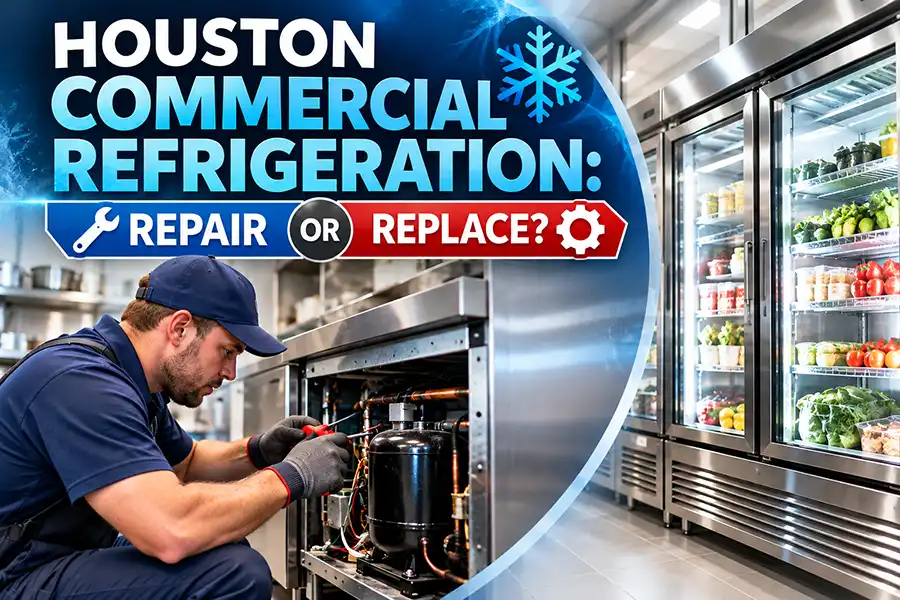
For a Houston restaurant, grocery store, convenience store, commercial kitchen, or other business that depends on refrigeration, equipment problems can quickly become expensive. A walk-in cooler may struggle to maintain temperature, a freezer may need repeated service, or an aging refrigerator may consume more electricity than expected.
When these problems arise, business owners face an important question: Should you repair the existing equipment or invest in a replacement?
The right decision depends on more than the age of the unit. Repair history, energy use, equipment condition, parts availability, business needs, and the risk of future downtime all matter.
For businesses looking for Houston commercial refrigeration service, Autumn Mechanical provides commercial refrigeration repair, maintenance, and installation. This guide explains how to evaluate your equipment and make a more informed decision.
Why the Repair-or-Replace Decision Matters
Commercial refrigeration equipment often operates for long hours under demanding conditions. Restaurants may open cooler doors repeatedly throughout a busy service, grocery stores rely on refrigerated display cases throughout the day, and commercial kitchens generate heat that can place additional demands on nearby equipment.
When a refrigeration system begins to fail, the immediate repair bill is only part of the cost to consider.
A business may also face:
- Spoiled or unusable inventory.
- Lost sales during equipment downtime.
- Emergency service expenses.
- Higher electricity consumption.
- Repeated disruption to employees and daily operations.
- The cost of replacing equipment at short notice.
Repairing a unit can be the sensible choice when the problem is limited and the equipment is otherwise in good condition. Replacement may be worth considering when major components are failing, repairs keep recurring, or the system no longer meets the business’s needs.
The goal is to compare the likely cost and reliability of each option—not automatically choose the cheapest immediate fix.
1. Consider the Age and Overall Condition of the Equipment
Age is a useful starting point, but it should not determine the decision by itself. Commercial refrigeration equipment has different expected service lives depending on its design, workload, installation, maintenance history, and operating environment.
A relatively old unit that has been maintained consistently may still be worth repairing. A newer unit with a major failure or an unsuitable design may require a different solution.
During an evaluation, consider:
- The manufacturer’s model and installation date.
- Whether the equipment has been maintained regularly.
- The condition of major components.
- Whether the unit maintains the required temperatures.
- Whether parts are available.
- Whether the equipment is appropriately sized for the current operation.
Ask the technician to explain the condition of the system and identify the specific issue rather than recommending replacement based on age alone.
For a professional assessment, review Autumn Mechanical’s commercial refrigeration services in Houston.
2. Compare the Repair Cost With the Cost of Replacement
A repair estimate provides only one part of the financial picture. Compare it with the full cost of installing replacement equipment.
A replacement estimate may include the unit itself, delivery, installation, electrical or plumbing adjustments, removal of the old equipment, commissioning, and any necessary changes to the surrounding space.
Also consider whether replacement would improve the way your business operates. A more appropriate unit may provide better storage capacity, easier access, improved temperature control, or features that fit the workflow of your kitchen or retail space.
A simple comparison can help organize the decision:
| Consideration | Repair may make sense when… | Replacement may make sense when… |
|---|---|---|
| Current fault | The issue is isolated and repairable | Major components have failed or several issues exist |
| Repair history | Service calls are infrequent | Breakdowns and expenses keep recurring |
| Energy use | Performance remains reasonable | The system consumes excessive energy relative to suitable alternatives |
| Parts | Required parts are available | Parts are difficult to obtain or no longer supported |
| Capacity | The unit fits current needs | The business needs different capacity or functionality |
| Reliability | The equipment operates consistently after repair | Continued downtime presents a significant business risk |
These are general guidelines, not a substitute for an equipment-specific assessment. A technician can help you compare realistic repair and replacement options.
3. Look at Your Repair History
One repair does not necessarily mean a refrigeration system is nearing the end of its useful life. However, a pattern of recurring problems deserves attention.
Review service records and ask:
- How often has the equipment required repair?
- Which components have failed?
- Are the same problems returning?
- Have repair costs increased over time?
- Has the unit repeatedly failed to maintain temperature?
- Have breakdowns interrupted business operations?
If several major components have required service in a short period, another repair may not resolve the underlying reliability concerns.
On the other hand, if the technician identifies a clear, limited problem and the rest of the equipment is in good condition, repair may be the more practical option.
A useful decision should account for the equipment’s overall condition, not simply the latest service invoice.
4. Evaluate Energy Consumption and Operating Costs
Refrigeration systems can contribute significantly to a commercial property’s electricity use because they often operate for extended periods.
Dirty coils, damaged door gaskets, restricted airflow, control problems, and other mechanical issues can affect performance. Maintenance or repair may correct some of these problems without requiring a new unit.
However, an older system may also be less efficient than a suitable modern replacement.
Before deciding, ask the technician to identify any correctable performance problems and discuss whether replacement equipment could reduce operating costs. If possible, use actual energy bills, operating hours, equipment specifications, and realistic efficiency estimates rather than relying on a generic savings percentage.
The U.S. Environmental Protection Agency’s ENERGY STAR program provides information about energy-efficient products and commercial building efficiency. Product availability and qualification depend on the specific equipment category.
Do not assume that a replacement will automatically pay for itself through lower electricity bills. Compare the purchase and installation cost with credible estimates of potential savings over the period you expect to use the equipment.
5. Consider the Risk of Business Downtime
For some businesses, refrigeration reliability is just as important as the equipment’s purchase price.
A restaurant that loses a walk-in cooler during dinner service may have to move ingredients, change menu offerings, or suspend certain operations. A grocery store with a failing freezer may face product loss and disruption to customers.
When evaluating repair versus replacement, consider the consequences of another breakdown.
Ask your refrigeration contractor:
- How serious is the current failure?
- Can the equipment operate reliably after the proposed repair?
- Are other major components showing signs of wear?
- Is replacement equipment readily available?
- How long could repair or installation take?
- Is there a practical way to reduce operational disruption during the work?
If the equipment is still maintaining safe conditions, you may have time to compare options. If it cannot maintain required temperatures, act promptly to protect inventory and follow applicable food-safety procedures.
For additional information on recognizing urgent problems, read When Houston Businesses Need Emergency Commercial Refrigeration Service.
6. Make Sure the Equipment Fits Your Business
Replacement can be an opportunity to correct a sizing or layout problem. But a new unit is not automatically better simply because it is newer.
Before choosing equipment, review:
- Required storage capacity.
- Peak operating demand.
- Available floor space and clearances.
- Door placement and staff access.
- Ambient temperatures around the equipment.
- Electrical and other utility requirements.
- Manufacturer installation and ventilation specifications.
- The type of products being stored.
For example, a busy restaurant may need a different configuration from a small convenience store. A unit that is too small may struggle during peak periods, while unnecessarily large equipment may increase initial costs and use space inefficiently.
Ask the contractor to explain how the proposed equipment matches your actual needs.
Autumn Mechanical provides commercial refrigeration installation and related services. Visit the commercial refrigeration service page to learn more.
7. Do Not Ignore Refrigerant and Environmental Considerations
Refrigerant-related problems should be diagnosed by a qualified professional. Simply adding refrigerant without identifying the cause of a loss may leave the underlying problem unresolved.
The appropriate service depends on the equipment, refrigerant, condition of the system, and applicable regulations.
The U.S. Environmental Protection Agency provides guidance on managing refrigerant in stationary refrigeration and air-conditioning equipment, including federal requirements involving refrigerant handling, recovery, and leak-related practices.
If a major refrigeration repair involves a refrigerant circuit or a component such as the compressor, ask the technician to explain the available options and whether the equipment remains a sensible long-term investment.
Environmental requirements and refrigerant availability may also affect the choice of replacement equipment. Confirm that any proposed system is appropriate for the application and complies with current requirements.
8. Build a Maintenance Plan After Repair or Replacement
Whether you repair an existing system or install new equipment, maintenance should be part of the long-term plan.
Preventive service can help identify developing problems before they cause major disruption. Depending on the equipment and manufacturer recommendations, maintenance may include inspecting coils, checking door gaskets, reviewing temperature performance, examining drainage, and evaluating other components.
A maintenance plan should reflect the equipment’s design, operating conditions, usage, and service history. A busy commercial kitchen may require a different schedule from a lightly used unit in another type of business.
For more guidance, read Benefits of Regular Commercial Refrigeration Maintenance.
Maintaining service records is also useful. Keep invoices, inspection notes, equipment model numbers, and details of recurring issues together. These records can help you evaluate future repair recommendations and plan replacement before an unexpected failure forces a rushed decision.
Frequently Asked Questions About Commercial Refrigeration
When should a commercial refrigerator be replaced instead of repaired?
Consider replacement when the equipment has recurring major failures, repair costs are substantial relative to a suitable replacement, required parts are difficult to obtain, or the unit no longer meets your operational needs. A professional assessment can help determine which option makes financial and practical sense.
Is it worth repairing an older walk-in cooler?
It can be. The decision depends on the condition of the refrigeration system, the specific fault, maintenance history, parts availability, energy performance, and the cost of replacement. Age alone does not establish that replacement is necessary.
Can commercial refrigeration maintenance reduce breakdowns?
Routine maintenance can help identify wear, airflow restrictions, damaged seals, and other developing issues. It cannot prevent every failure, but it can support more reliable operation when performed according to the equipment’s needs.
Should I replace a commercial refrigerator that uses too much electricity?
First, have the system evaluated to determine whether a repair or maintenance issue is contributing to excessive energy use. Then compare the likely cost of continued operation with the total cost and expected performance of a suitable replacement.
Who provides Houston commercial refrigeration repair and installation?
Autumn Mechanical provides commercial refrigeration repair, maintenance, and installation for businesses in Houston and surrounding areas. Contact the company to discuss the equipment, symptoms, and service options.
Houston Commercial Refrigeration Service From Autumn Mechanical
Deciding whether to repair or replace commercial refrigeration equipment requires a clear understanding of the problem, the condition of the system, and the demands of your business.
A targeted repair may be the best choice when the equipment is otherwise reliable. Replacement may be more practical when breakdowns recur, operating costs are excessive, or the unit no longer meets business requirements.
Autumn Mechanical provides commercial refrigeration repair, maintenance, and installation services for Houston-area businesses, including service for walk-in coolers, walk-in freezers, ice machines, reach-in units, and other commercial refrigeration systems.
Contact Autumn Mechanical
Commercial Refrigeration Department: 713-686-1001
Website: autumnmechanical.com/
Email: customercare@autumnmechanical.
Contact the team to discuss your equipment, request an evaluation, and compare repair and replacement options for your business.
Disclaimer: This article is for general informational purposes only. Equipment condition, operating costs, repair needs, refrigerant requirements, and replacement recommendations vary by system and application. Have qualified professionals assess the equipment before making a repair or replacement decision.